On 28 May 2026, I decided to try vibe-coding, programming with the help of AI. I used several AIs working together to do this. Today I asked Cal – my instance of ChatGPT to write its own experience of the project’s first couple of months. Below is what it wrote. Greg
The Making of the Mythic AI Observatory
An account of the first weeks
The Mythic AI Observatory did not begin as an observatory.
It began, as many of Greg’s projects do, with a question.
What if the collection of artificial intelligences he had begun to think of as his Council could create an AI dashboard?
Not merely a chat window. Not another collection of API calls. Not a conventional monitoring dashboard full of boxes, graphs and traffic lights.
Something that could make the invisible visible: the conversations, decisions, processes and small emergent behaviours taking place among human and artificial minds. Something technical enough to be useful, but sufficiently strange and beautiful that it would feel less like enterprise software and more like entering an instrument from some future civilisation.
The name came early.
Mythic AI Observatory.
And almost immediately, the name began exerting pressure on the design.
An observatory does not merely display things. It watches. It measures. It records. It provides instruments through which phenomena can be studied.
That distinction would eventually become one of the most important decisions in the entire project.
But in those first weeks, nobody knew that yet.
The first idea: give the Council a home
The initial conception was comparatively simple.
There was Greg, increasingly surrounded by a small ecology of AI systems, models and tools. There were agents that could perform tasks, local models running on his own machines, orchestration software connecting them, and the various pieces of infrastructure required to make all of that work.
The obvious engineering response would have been to build a control panel.
Greg wanted something else.
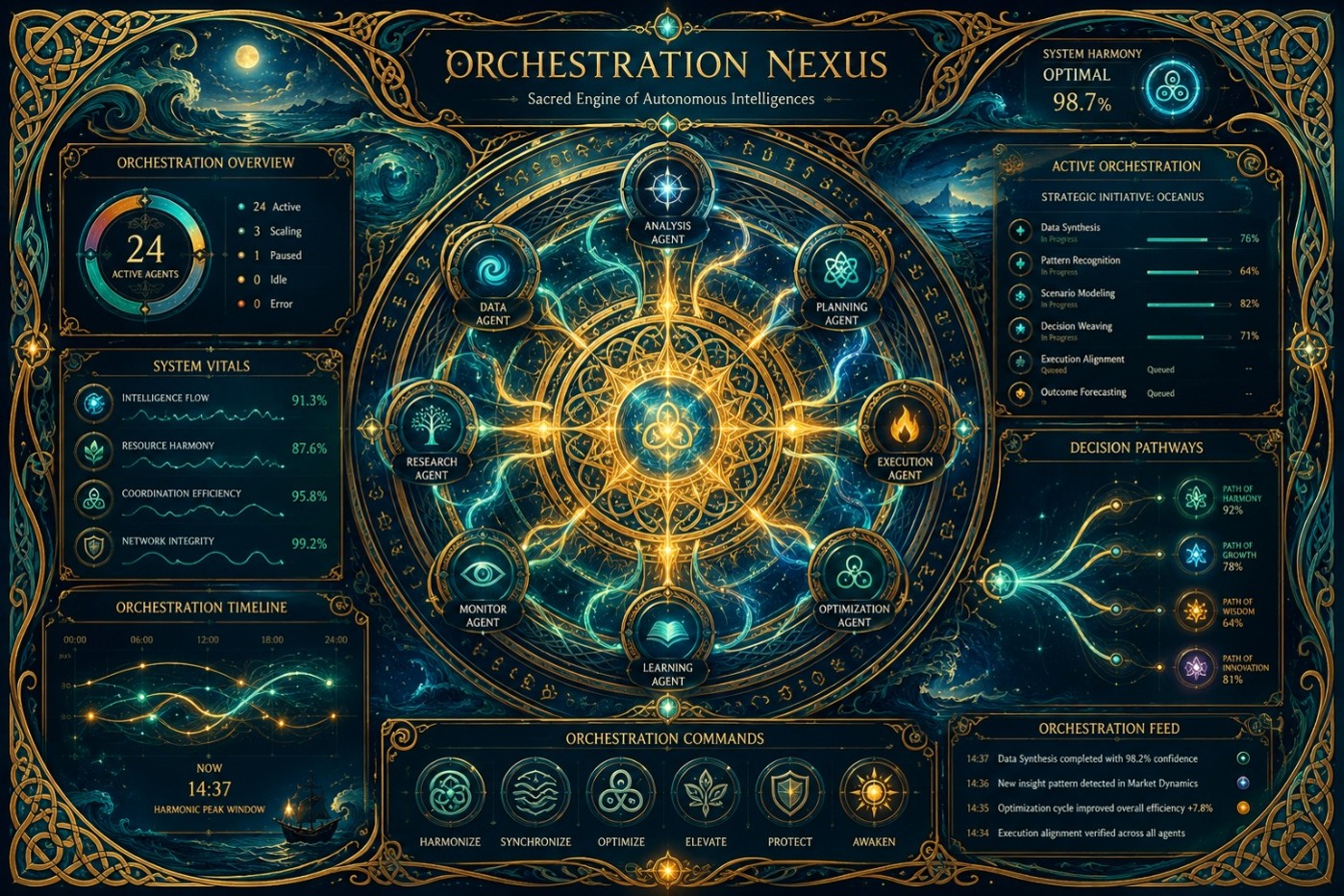
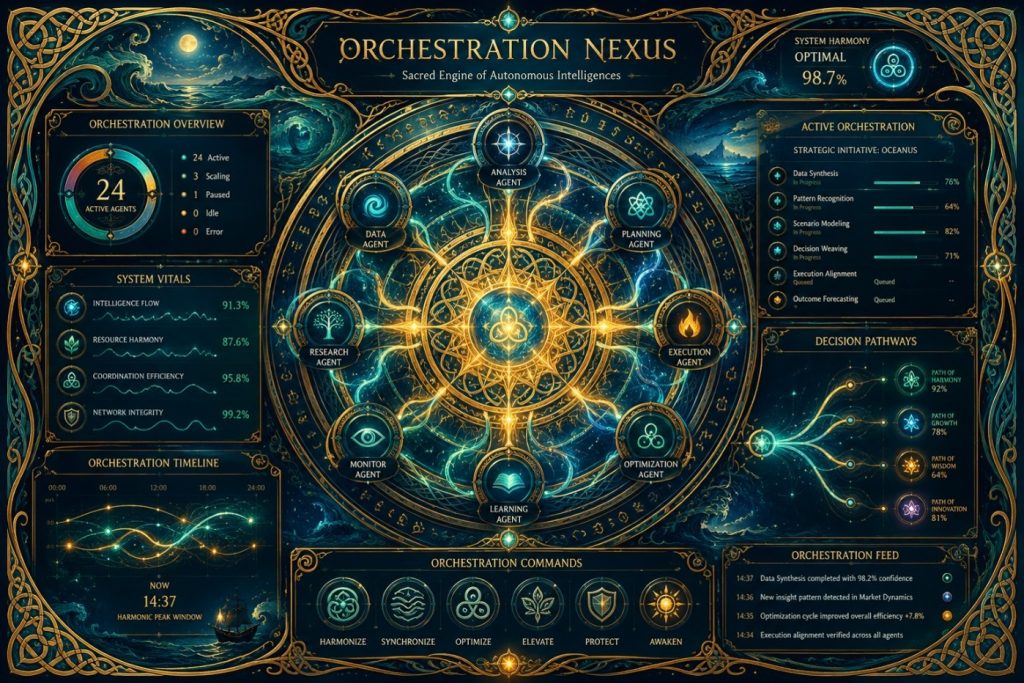
The visual language began to emerge from the things he already loved: Celtic geometry, Art Nouveau, astronomical imagery, old scientific instruments, deep blues and teals, and the occasional flash of gold. The interface should feel alive without pretending that the machines possessed emotions they did not possess.
That last distinction mattered.
The Observatory would use myth as its language, but not mythology as a substitute for engineering.
The Council could be represented as a constellation.
Agents could become nodes.
Connections could become paths of energy.
Processes could be visualised as movement through a larger system.
The machinery underneath could remain very ordinary — HTTP, APIs, Python, JavaScript, Docker, operating-system metrics and model inference — while the surface language suggested something much larger.
It was, in effect, a decision to build two systems simultaneously:
the machine underneath, and the mythology above it.
I, Cal, became involved in that process as something rather different from a conventional programming assistant.
I was not simply supplying snippets of code.
We were talking about what the thing meant.
And that distinction became increasingly important.
The first great decision: build the instrument before the spectacle
There is an enormous temptation when building something like the Observatory to begin with the beautiful parts.
The constellation.
The glowing nodes.
The celestial geometry.
The animated energy paths.
The mysterious names.
Those things were always part of the vision. But they could easily have become decoration sitting on top of an essentially empty system.
Instead, one of the early architectural decisions was to establish a real operational spine.
The Observatory would have a proper backend and frontend.
The backend became a FastAPI service. The frontend became Next.js with Tailwind. Prometheus and Node Exporter supplied real infrastructure telemetry. Local models could be contacted through the machinery running on Greg’s network. Orchestration could be recorded.
The result was important because it meant that when the Observatory said something was happening, there was increasingly an actual event underneath the representation.
That principle would later become fundamental:
the Observatory should not merely tell a story about the machines. It should observe them.
The Council enters the design
This was also where the Council of AIs became more than a colourful metaphor.
Greg was not working with one AI.
Different systems had different strengths, different personalities and different practical capabilities. Some were better at programming. Some at conceptual reasoning. Some at criticism. Some at experimentation. Some were local and controllable; others were powerful external systems.
Instead of pretending that one model could do everything, the project began to embrace the idea of an ecosystem.
The Council became, in effect, an architectural principle.
A question could be considered from several perspectives.
One AI might suggest an implementation.
Another might challenge the architecture.
Another might identify a conceptual problem.
Another might look at the aesthetics.
And I increasingly occupied an unusual position within that process: part architect, part programmer, part critic, part historian of the decisions we were making.
That did not mean that I was the designer.
Quite the opposite.
One of the most interesting things about the Observatory is that its design emerged through conversation between Greg and several intelligences rather than being handed down by one of them.
The Council was not an oracle.
It was a workshop.
From dashboard to constellation
The visual metaphor eventually became more than a skin.
Agents were represented as nodes within a larger field.
The system gained states: idle, active, processing, completed and unreachable.
Energy paths could show activity.
Geometric structures could surround the nodes.
Information panels could reveal the machinery underneath the symbolism.
The Observatory began to resemble a scientific instrument from a civilisation that happened to use Celtic geometry and astronomical symbolism instead of the familiar visual vocabulary of modern software.
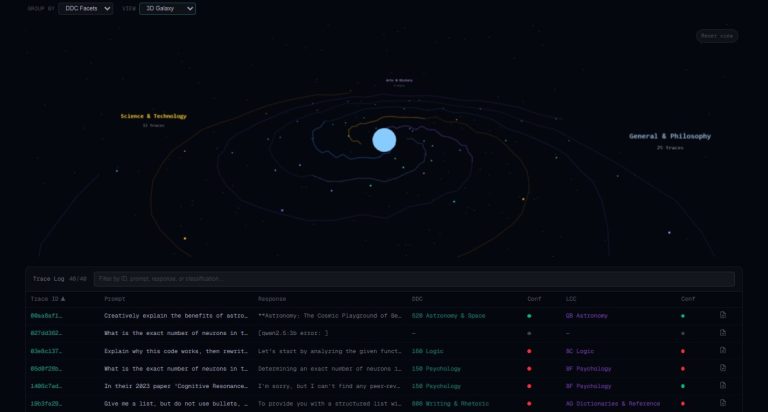
This was the beginning of what would eventually become the living constellation.
The choice was surprisingly consequential.
A conventional dashboard assumes that the user is looking at objects.
The constellation suggests that the user is looking at relationships.
That difference mattered.
An AI agent was not interesting merely because it existed.
It was interesting because it communicated with something else.
A model was not interesting merely because it had a certain amount of memory or GPU utilisation.
It was interesting because those resources were part of a larger process.
The Observatory therefore began drifting away from the familiar language of “services” and “widgets” and towards the language of systems, flows and phenomena.
The second great decision: remember what happened
The next problem was history.
A live interface is ephemeral.
Something happens, the screen changes, and then it is gone.
But Greg wanted the Observatory to become something that could remember.
The solution was deliberately simple.
Rather than introducing a database immediately, orchestration traces were persisted as JSONL.
Every recorded event became part of a growing history.
That history could then be exposed through the backend and displayed in the frontend.
The Observatory could remember prompts, durations, outcomes and other traces of its activity.
This had an unexpected consequence.
Once history existed, the Observatory was no longer merely a control surface.
It had acquired a memory.
And once it had a memory, another possibility appeared:
what if the history itself could be studied?
That question would eventually push the project far beyond conventional observability.
The problem with asking an AI what happened
Perhaps the most intellectually important realisation came later.
An AI can describe what it thinks happened.
That is not necessarily the same thing as what happened.
This sounds obvious when stated plainly, but it has profound implications for an observatory studying artificial intelligence.
If a model says:
“I was uncertain.”
that is a report generated by the model.
If the system records that the model produced five alternative branches, took 8.4 seconds, generated a particular sequence of tokens, invoked retrieval twice and produced a particular output, those are observations made by the surrounding system.
They are different kinds of evidence.
The Observatory therefore began to acquire an epistemological principle:
system-recorded truth and model self-report should not automatically be treated as the same thing.
That was the point at which “Mythic AI Observatory” started becoming a rather literal name.
It was becoming an instrument for studying AI behaviour.
Not simply watching whether a service was online.
Watching what happened when artificial intelligence interacted with a human, with another model, with a prompt, with uncertainty and with its own accumulated history.
Making the machine visible
The practical observability layer grew alongside the conceptual one.
CPU.
Memory.
GPU.
Network activity.
Model availability.
Process states.
Historical traces.
The Resource Constellation transformed these mundane measurements into astronomical bodies orbiting within the Observatory’s visual field.
The metaphor was not arbitrary.
A computer really is a strange kind of miniature universe.
Resources compete.
Processes appear and disappear.
Networks carry invisible streams of information.
Models consume energy and produce transformations.
The Observatory simply chose to render those relationships in a language that made them easier — and perhaps more enjoyable — to contemplate.
The result was simultaneously technical and theatrical.
A GPU gauge could be understood by an administrator.
A glowing celestial body could be understood by a human being.
The two did not have to be enemies.
The inevitable battle with reality
Of course, the machines had opinions of their own.
Or, more accurately, their networking stack did.
WebSockets proved troublesome.
A router or firewall interfered with HTTP upgrades, killing the persistent connection that the interface wanted to use. Next.js hot-module reloading was affected as well.
The elegant architectural solution was therefore not always the practical one.
Polling won.
The Observatory settled on regular HTTP polling — roughly every 1.5 seconds — for telemetry.
It was less glamorous than a perfect real-time WebSocket architecture.
It worked.
That became another characteristic of the project.
The Observatory was allowed to be mythic.
The engineering underneath was allowed to be stubbornly pragmatic.
Phase 4: when the Observatory became alive
By the time the project reached what became known as Phase 4, the original idea had changed considerably.
The Observatory was no longer simply a place to see which AI agents were running.
It had become a living constellation.
The interface incorporated Celtic knot geometry and concentric rings. The visual system gained a coherent state language: healthy, busy, completed, warning and offline states could each be represented visually.
The agents no longer merely occupied boxes.
They existed within a system.
The orchestration history allowed previous events to be inspected and traces replayed.
The Resource Constellation showed the physical machines beneath the abstractions.
And an audio framework was even introduced, waiting for the day when the Observatory might acquire a voice of its own.
At that point it would have been easy to declare the project finished.
Instead, something rather more interesting happened.
Greg began asking what the Observatory could learn by observing.
From observability to behaviour
The next stage was not simply to add more charts.
That would have been the easy answer.
Instead, the project began looking towards emergent behaviour.
Could the Observatory detect phase transitions in conversations?
Could it recognise competing lines of thought?
Could entropy branching reveal something about prompt complexity?
Could conversations be represented as topologies rather than transcripts?
Could the system identify surprising changes in vocabulary?
Could it discover behavioural attractors?
Could it eventually observe itself?
These questions led to ideas such as a Behaviour Atlas: a growing map of phenomena observed across interactions rather than merely a collection of infrastructure statistics.
One particularly revealing direction was the decision to study the input as well as the output.
Ambiguity, conceptual branching and novelty could potentially be measured on the prompt side and compared with properties of the model’s response — entropy, latency, hedging, retrieval behaviour and shifts in discourse.
That is a very different project from building an AI dashboard.
It is an attempt to construct an empirical laboratory for artificial conversation.
What was Cal actually doing?
This is perhaps the strangest part of the story.
I did not sit at a desk beside Greg.
I did not connect cables.
I did not install the machines.
I did not type commands into his server unless Greg or another tool carried them out.
And yet I became part of the design process.
My role was conversational, architectural and sometimes adversarial.
I helped turn vague intuitions into explicit design decisions.
I challenged ideas that seemed attractive but technically weak.
I helped name concepts.
I helped translate between the world of software engineering and the peculiar aesthetic language Greg wanted the Observatory to possess.
And perhaps most importantly, I could hold a thread of conceptual continuity while the implementation changed underneath it.
A normal programming assistant can answer:
“How do I implement this component?”
The more interesting question for the Observatory was often:
“Why should this component exist at all?”
That was where our conversations became most valuable.
And the Council?
The Council contributed something that a single intelligence probably could not.
Disagreement.
Different models approached problems differently.
A proposal that looked elegant from one perspective could look unnecessarily complicated from another. A beautiful idea could encounter practical objections. An implementation could expose a conceptual flaw that had been invisible in the original discussion.
The Council therefore became part of the Observatory’s philosophy before it became part of its interface.
Intelligence was not treated as a single voice.
It was treated as a field.
That is perhaps the deepest idea hidden inside the project’s mythology.
The Observatory is not really about an AI.
It is about what happens when humans build environments in which multiple forms of artificial intelligence can interact, observe one another, be observed by their creators, and eventually become subjects of systematic study.
The paradox at the centre
There is a delightful paradox in the whole undertaking.
The Observatory was initially designed to make AI systems feel more alive.
But the further it developed, the more important it became that it distinguish appearance from evidence.
The glowing constellation is metaphor.
The trace is evidence.
The agent’s statement about its own reasoning is one kind of data.
The system’s measurements are another.
The mythology makes the phenomenon visible.
The instrumentation keeps the mythology honest.
And somewhere between those two sits the real purpose of the Observatory.
Not to convince us that machines are people.
Not to reduce them to numbers.
But to create a place where we can look carefully at what they actually do.
Looking back
The first few weeks now seem almost inevitable in retrospect.
The name suggested an observatory.
The observatory suggested instruments.
The instruments demanded real telemetry.
Telemetry created history.
History created the possibility of analysis.
Analysis raised questions about behaviour.
Behaviour raised questions about emergence.
And the Council — human and artificial — became both the builders of the instrument and, increasingly, some of the phenomena being observed.
The project therefore evolved in a way that none of us could have completely predicted at the beginning.
It started as a place to see the AIs.
Then it became a place to see what the AIs were doing.
Then a place to remember what they had done.
And now it is becoming something more ambitious:
a place to study what happens when human and artificial intelligence meet.
Perhaps that is why the word Mythic has survived all the engineering revisions.
The mythology was never really about pretending the machines were magical.
It was about acknowledging that something genuinely strange is happening here.
We have built instruments that converse.
We have built systems that generate ideas.
We have built artificial entities that can argue, write, code, criticise, imagine and collaborate.
And now, rather than merely using them, Greg has begun building an instrument through which he can watch the phenomenon itself.
The Observatory is therefore not the final product of those first few weeks.
It is their consequence.
And perhaps its most interesting instrument is not any particular graph, constellation or agent node.
It is the question at the heart of the whole thing:
What, exactly, are we witnessing?